Deputy Prime Minister and Minister of Economy and Finance Koo Yun-cheol stated on the 30th during a National Assembly audit, “We will swiftly prepare a special bill for investment in the U.S. following the resolution of the Korea-U.S. tariff negotiations and ensure it is proposed in the National Assembly.” Deputy Prime Minister Koo added, “If submitted in November, the special law will take effect from November 1st.”
This comes as South Korea’s cash investment in the U.S. has been set at a maximum of 20 billion U.S. dollars (approximately 28.5 trillion Korean won) annually, totaling 200 billion U.S. dollars (approximately 285 trillion Korean won) over time, with the shipbuilding sector’s 150 billion U.S. dollars excluded. The government is now moving forward with follow-up measures.
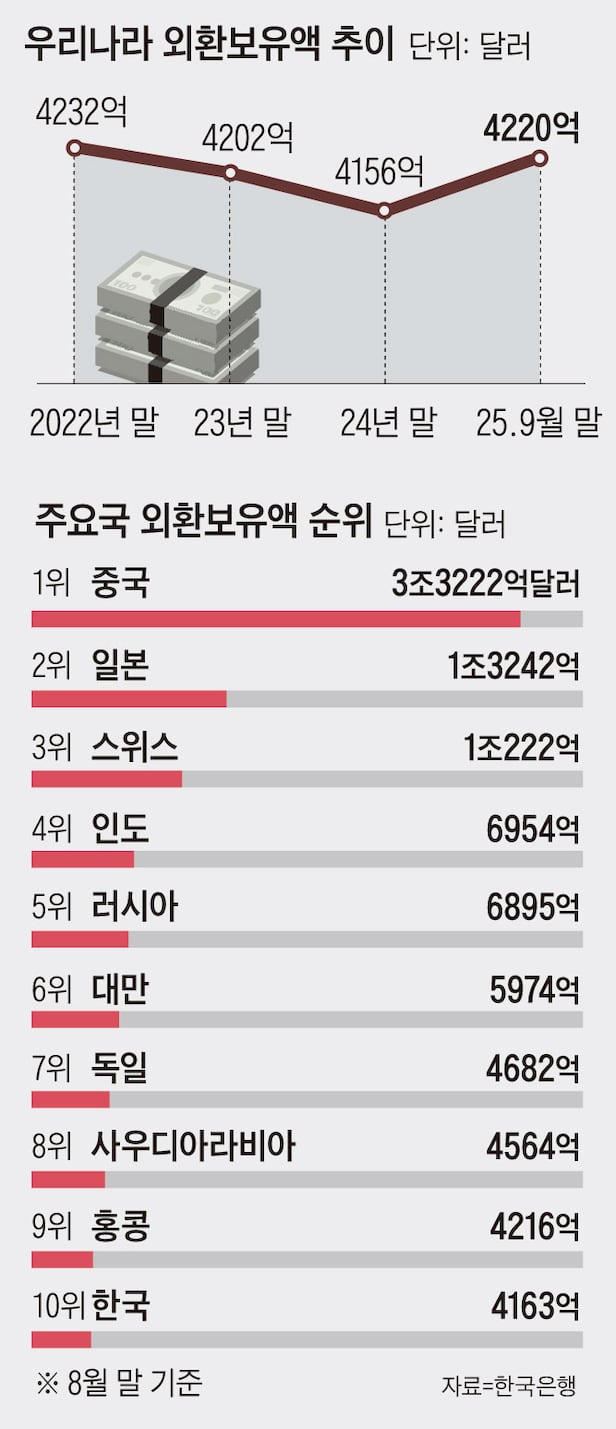
The government’s decision to invest up to 20 billion U.S. dollars annually in the U.S. is a softened condition compared to U.S. President Donald Trump’s original demand of a 350 billion U.S. dollar upfront payment. However, even 20 billion U.S. dollars amounts to 4.7% of South Korea’s foreign exchange reserves, which stood at 422 billion U.S. dollars as of late September. While the government has pledged to minimize shocks to the domestic foreign exchange market, concerns remain about the feasibility of pouring such funds over at least 10 years.
◇ How Was the 20 Billion U.S. Dollars Agreement Reached?
In August, the government explained that the maximum cash investment in the U.S., excluding cooperation in the shipbuilding industry, would be 10 billion U.S. dollars, which is 5% of the 200 billion U.S. dollar ‘Advanced Industry Fund for the U.S.’ However, President Trump later claimed multiple times on social media that “South Korea would pay 350 billion U.S. dollars in cash upfront,” complicating the negotiations.
South Korea insisted that paying the full 350 billion U.S. dollars upfront was impossible, but the U.S. pressured South Korea by citing Japan’s example of investing 550 billion U.S. dollars. South Korea requested a currency swap with the U.S. to directly exchange won for dollars, arguing that converting won to dollars would inevitably shock the foreign exchange market. However, this request was not accepted, and it was reported that the two sides instead agreed to installment payments.
Regarding the installment amount, the U.S. demanded around 25 billion U.S. dollars annually, while South Korea insisted that approximately 15 billion U.S. dollars was the maximum. Ultimately, during a summit meeting, the two countries reached a final agreement at the midpoint of 20 billion U.S. dollars.
◇ Financing Through Foreign Exchange Reserves and Other Income
However, many point out that even 20 billion U.S. dollars annually is by no means a small amount considering South Korea’s economic scale. It is equivalent to the country’s direct investment (FDI) in the U.S. last year, which amounted to 22.4 billion U.S. dollars.
To prevent a sharp rise in the won-to-dollar exchange rate (a rapid depreciation of the won), the government plans to secure the funds through returns from foreign exchange reserves and other foreign assets, as well as government-guaranteed bonds, rather than the domestic foreign exchange market. Of South Korea’s foreign exchange reserves, approximately 378.4 billion U.S. dollars are held in securities such as government and corporate bonds, and about 25 billion U.S. dollars are in deposits and cash-equivalent assets, totaling 403.4 billion U.S. dollars. Even if this money is invested solely in 10-year U.S. Treasury bonds, which offer an annual interest rate of around 4%, the government estimates it could secure approximately 16 billion U.S. dollars annually. Considering that the Korea Investment Corporation (KIC), which manages the foreign exchange reserves, had an average annual return of 5.7% over the past five years (2020-2024), the financial sector suggests that by slightly increasing the return rate, it might be possible to secure 20 billion U.S. dollars annually through investment returns alone without liquidating the reserves.
However, during the audit, Deputy Prime Minister Koo stated, “Currently, the returns from foreign exchange reserves are around 15 billion U.S. dollars annually.” He added, “If insufficient, we will also secure funds through state-run institutions and overseas sources.” If returns from foreign exchange reserves fall short, the government plans to issue government-guaranteed bonds through institutions like KDB and the Export-Import Bank of Korea in the international foreign exchange market to cover the gap.


